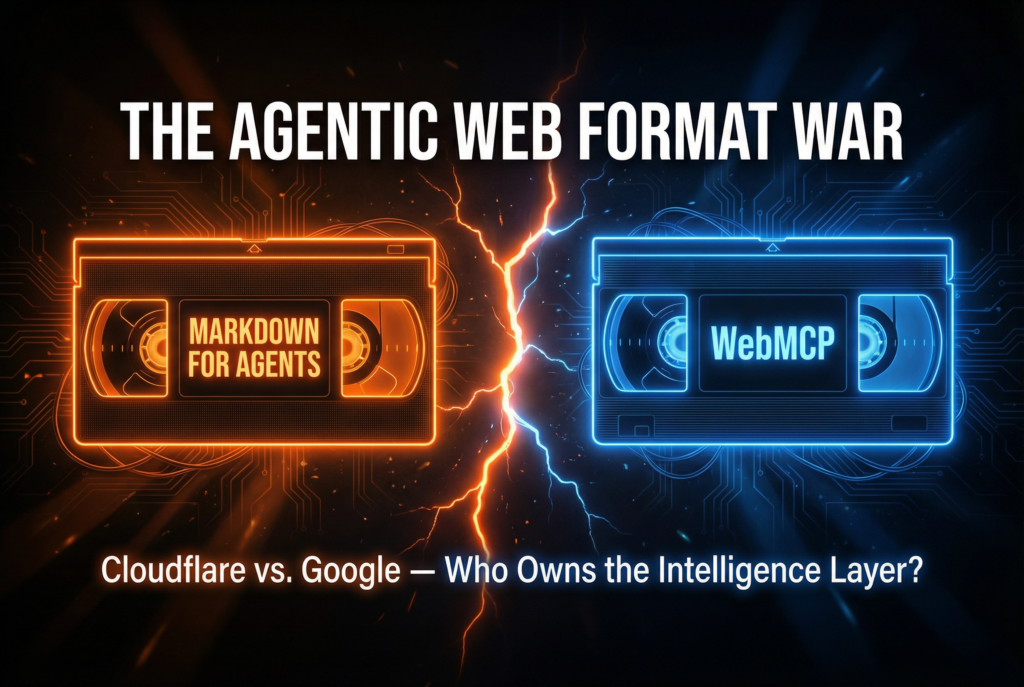
The Shift: The internet is transitioning from human-read HTML to machine-read data. AI agents are already crawling the open web independently of Google’s search index.
The Contenders: Cloudflare’s Markdown for Agents (optimizing content for agents) vs. Google’s WebMCP (optimizing actions for agents).
The Hypocrisy: Google is calling Markdown for Agents “cloaking” — despite building the exact same mechanism with AMP for years.
The Proof: A March 2026 experiment showed OpenAI’s GPTBot crawling a brand-new, unindexed site 470× more aggressively than Googlebot.
The Verdict: Cloudflare is winning the distribution game through zero-friction adoption. This is the VHS vs. Betamax moment of the Agentic Web.
The internet is changing from something humans read into something machines read. And right now, there is a massive fight over who owns the plumbing.
In February 2026, Cloudflare and Google launched competing visions for how AI agents should interact with websites. At first glance, these tools solve different problems. Cloudflare is addressing how agents read the web, while Google is addressing how agents take action on the web. But look beneath the surface, and it becomes clear that this is a strategic format war over who will control the intelligence layer of the internet for the next decade.
Two Competing Visions for the Agentic Web
Cloudflare launched Markdown for Agents on February 12, 2026. It uses HTTP content negotiation. When a bot like Claude Code or GPTBot requests a page, Cloudflare strips away the heavy HTML and serves a lightweight Markdown file instead. It cuts token usage by up to 80%. Website owners just flip a switch in their dashboard. Zero code required.
Google launched WebMCP (Web Model Context Protocol), a browser API that lets developers explicitly declare structured functions to AI agents. Instead of a bot scraping a page to figure out how to click a button, the site exposes a clean buyTicket() function. It is robust and highly reliable — but it requires real developer effort and currently only works in Chrome Canary.
| Dimension | Cloudflare Markdown for Agents | Google WebMCP |
|---|---|---|
| Layer | Content (passive reading) | Action (structured execution) |
| Mechanism | HTTP Accept: text/markdown header | Browser API (navigator.modelContext) |
| Adoption Friction | Near-zero — dashboard toggle | High — dev implementation required |
| Immediate Web Reach | ~20–22% of global traffic | Chrome 146 Canary only |
| Token Efficiency | 80% reduction vs HTML | 67% vs visual scraping |
| Search Engine Stance | Opposed (Google, Bing) | Supported (Google’s own protocol) |
| Standardization Body | De facto (Cloudflare + Vercel) | W3C Community Group (formal) |
Technically, these two things do different jobs. But strategically, they are at war. Cloudflare wants the edge network to be the intelligence layer — agents read the open web directly, bypassing traditional search indexes. Google wants the browser to remain the intelligence layer, keeping Google right where it has always been: in the middle of every transaction.
The AMP Hypocrisy
Google and Microsoft are not happy about Cloudflare’s move. They are publicly discouraging publishers from using Markdown for Agents. Their stated reason is “cloaking” — arguing that serving a different version of a page to a bot than you serve to a human creates a dangerous shadow web.
“When you flatten a page into markdown, you don’t just remove clutter. You remove judgment, and you remove context… The moment you publish a machine-only representation of a page, you’ve created a second candidate version of reality.”
— Jono Alderson, Technical SEO Consultant
It is a weak argument. For years, Google aggressively pushed the Accelerated Mobile Pages (AMP) project. The entire point of AMP was to serve an alternate, stripped-down version of a web page specifically for mobile clients — using the exact same HTTP content negotiation mechanism that Markdown for Agents uses today.
Serving machine-optimized content to a phone was called innovation. Serving machine-optimized content to an AI agent is called cloaking. The only difference is who owns the infrastructure.

Google AMP and Cloudflare Markdown for Agents use an architecturally identical mechanism. The only difference is who owns the infrastructure.
Google isn’t afraid of cloaking. They are afraid of disintermediation. Markdown for Agents enables a “data web” that bypasses their core search index business. WebMCP is their counter-move to keep the browser — and by extension, Google’s ecosystem — central to every agentic workflow.
The GPTBot Experiment: Agents Don’t Need Google’s Index
If you want to know why traditional search engines are nervous, look at how agents are actually behaving in the wild right now.
In early March 2026, AI researcher Metehan Yesilyurt ran an experiment. He deployed a programmatic website with 60,000 AI-generated pages on a brand new domain. It had zero backlinks. Nobody shared it on social media. He didn’t submit it to Google Search Console.
Within minutes of the site going live, OpenAI’s GPTBot found the XML sitemap. It immediately started crawling the site at a rate of one request per second.

Source: Metehan Yesilyurt — StateGlobe.com Experiment (March 2026). Zero backlinks · Not submitted to Search Console · Found via XML sitemap only.
During a tracked 3-hour window, GPTBot made 5,200+ requests while Googlebot made just 11. GPTBot was 470 times more aggressive than Google’s crawler.
The takeaway is massive: Agents no longer rely on Google’s search index to discover the web. They are crawling the open internet and building their own real-time understanding of it. Cloudflare’s Markdown for Agents pours gasoline on this trend by making it incredibly cheap and fast for agents to consume content at scale.
The VHS vs. Betamax Reality
We’ve seen this play out before. In the late 1970s, Sony’s Betamax was widely considered technically superior to JVC’s VHS. Better resolution. Better hardware. Better quality. VHS won anyway — because it optimized for distribution, open licensing, and zero consumer friction.
WebMCP is Betamax. It is a highly structured, arguably superior technical implementation for agent interaction. But it requires real developer effort to build action manifests and integrate APIs. It currently lives in a single browser’s experimental build.
Markdown for Agents is VHS. It is a brute-force, “good enough” solution. But the adoption friction is zero. By simply adding a toggle to their dashboard, Cloudflare made roughly 20% of the internet agent-ready overnight. Vercel is now supporting Markdown output as well.
| Success Factor | Cloudflare (VHS) | Google WebMCP (Betamax) |
|---|---|---|
| Technical Quality | 6 / 10 | 9 / 10 |
| Ease of Adoption | 10 / 10 | 4 / 10 |
| Distribution Network | 10 / 10 | 3 / 10 |
| Ecosystem Coalition | 8 / 10 | 5 / 10 |
| Search Engine Support | 3 / 10 | 10 / 10 |
| Immediate Web Reach | ~20–22% overnight | Chrome Canary only |
In platform battles, the technology with the lowest friction and widest distribution almost always wins. Unless Google figures out how to drastically reduce the friction of implementing WebMCP — or forces adoption through search ranking penalties — Cloudflare is going to establish the dominant interface for the agentic web.
The Verdict
For technical and marketing leaders, the playbook is straightforward. Turn on Markdown for Agents today to capture the early wave of agentic traffic. Keep an eye on WebMCP for the future. And stop assuming your digital visibility depends entirely on a traditional search index. That era is ending.
Frequently Asked Questions
References
- Martinho, C., & Allen, W. (2026, February 12). Introducing Markdown for Agents. The Cloudflare Blog. blog.cloudflare.com
- tipsheet.ai. (2026, February 17). Agentic opportunity: WebMCP & Markdown for Agents. tipsheet.ai
- Golan, R. (2026, February 14). Two New Interfaces for the Agentic Web. LinkedIn. linkedin.com
- Vaughan-Nichols, S. J. (2026, February 22). Cloudflare’s Markdown for Agents automatically make websites agent-ready. The New Stack. thenewstack.io
- Goodwin, D. (2026, February 13). Cloudflare’s Markdown for Agents AI feature has SEOs on alert. Search Engine Land. searchengineland.com
- Yesilyurt, M. (2026, March 4). I Built a 60,000-Page AI Website for $10: GPTBot Crawled It 30,000+ Times in 12 Hours. metehan.ai. metehan.ai
- Weber, C. (2026, March 24). How to Serve Markdown to AI Agents Without Breaking Your SEO. Pronovix. pronovix.com